
If you have ever stood in a long queue at a government office waiting to verify a ration card or check a school record, you know exactly what India’s pre-digital governance felt like. Endless paperwork, manual registers, and no way of knowing whether your data was accurate or even existed in the system at all.
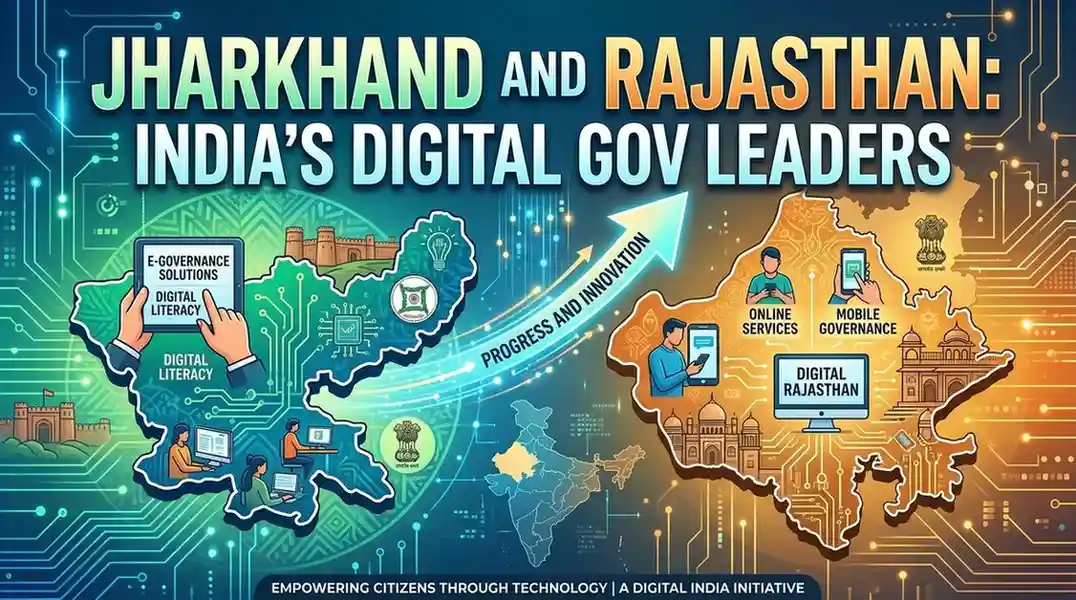
That experience is becoming a memory. Across India, state governments have been building digital portals that handle what used to require multiple office visits, physical documents, and weeks of waiting. Among all the states that have taken this seriously, Jharkhand and Rajasthan stand out as two of the most committed — each approaching digital governance from a different angle but arriving at the same destination: services that actually work for the people who need them.
This article takes a detailed look at how both states have built their digital infrastructure, what makes each approach unique, and what the rest of India can learn from their progress.
The Scale of the Challenge India Faced
India’s governance challenge is unlike almost any other country in the world. With over 1.4 billion people spread across 28 states, each with their own administrative structures, languages, and demographic profiles, delivering consistent government services has always been extraordinarily difficult.
The core problems were structural. Data existed in silos — a teacher’s service record might be in one file at the district education office while their salary details sat in a completely different department. A ration card beneficiary’s name might appear on multiple lists, enabling fraud. A student’s academic record had no central home and could easily be lost or manipulated.
The Digital India initiative provided the national framework and funding to address this. But the real work happened at the state level — because governance in India is ultimately state-delivered. Jharkhand and Rajasthan both grabbed this opportunity with both hands, investing in digital systems that would change how millions of citizens interacted with their governments.
Jharkhand’s Approach: Food Security First
Jharkhand’s most significant digital governance achievement is in the area where it matters most for its population — food security. The state runs one of the most technically sophisticated Public Distribution System (PDS) portals in the country through the Aahar Jharkhand platform, which handles ration card management, beneficiary verification, and monthly grain allocation tracking for millions of families.
What the Aahar Platform Actually Does
The Aahar Jharkhand portal is not simply a directory of information. It is a live transaction system. Every time a beneficiary collects grain from a Fair Price Shop, the transaction is recorded in real time through a biometric e-POS device. This means the government knows — within hours — whether a family received their entitled quota, whether the dealer distributed the correct quantity, and whether any irregularities are occurring at a specific location.
The portal’s beneficiary search function allows any citizen to check their ration card status, verify family member details, and confirm whether their monthly eligibility is active — without visiting any government office. This single feature has reduced the workload at district supply offices significantly and given citizens a level of self-service access they never had before.
The e-KYC Verification Drive: Removing Ghost Beneficiaries
One of Jharkhand’s boldest moves has been the mandatory Aadhaar e-KYC verification drive that began in early 2026. The government identified a significant number of inactive, duplicate, or fraudulent entries in the ration card database — what officials call ghost beneficiaries — and launched a state-wide campaign to clean the records.
Every family member listed on a ration card must now complete biometric verification at their local Fair Price Shop. If verification is not completed, that individual’s grain quota is automatically suspended until the process is done. This approach is firm — it inconveniences some genuine beneficiaries in the short term — but the long-term result is a cleaner, more accurate database that ensures subsidized food reaches only those who are genuinely entitled to it.
Jharkhand also built accommodations for vulnerable citizens into this system. Elderly residents, people with disabilities, and those whose fingerprints have become difficult to scan can complete an offline verification through their Block Supply Officer by submitting a physical self-declaration form. This shows a maturity in system design that goes beyond just digitizing forms — it accounts for the real human situations that rigid digital systems often miss.
Rajasthan’s Approach: Education Management at Scale
While Jharkhand focused its digital energy on food security, Rajasthan made education its primary battleground for digital transformation. The state manages one of the largest networks of government schools in India, and coordinating staff records, student data, school infrastructure reporting, and academic results across tens of thousands of institutions was a challenge that paper-based systems simply could not handle.
Rajasthan’s answer was to build a centralized education management system that connected every stakeholder in the school ecosystem. The Rajasthan school portal brings together school administration, teacher service management, student academic tracking, and public information access in a single integrated platform — eliminating the fragmented, office-by-office system that existed before.
What the Education Portal Manages
The scope of what Rajasthan’s education portal handles is impressive. On the staff side, every government school teacher in the state has a digital service profile — containing their qualifications, posting history, transfer records, leave balances, and salary details. A teacher who was transferred from one district to another no longer needs to carry a physical service book to their new posting. Their entire record follows them digitally.
For schools, the portal functions as a compliance and reporting hub. School principals can submit mandatory reports online, update infrastructure data such as classroom counts and toilet facilities, and receive communications from the district education office — all without leaving the school. This has reduced the administrative burden on school heads, giving them more time to focus on what actually matters: teaching.
Citizens also benefit from the public access features. Parents can search for any government school in Rajasthan, check its official category, staff strength, and available facilities before choosing where to enroll their child. This kind of transparency was simply not possible in the pre-digital era and represents a genuine shift in the power dynamic between citizens and public institutions.
What Connects Both States: The Common Principles
At first glance, a ration card portal and a school management system might seem like completely different types of digital infrastructure. But look more carefully and the same core principles are running through both.
- Centralised, verifiable data: Both systems replace fragmented paper records with a single source of truth. Whether it is a teacher’s service book or a family’s ration entitlement, the data is stored in one place, updated in real time, and accessible to authorised users from anywhere.
- Aadhaar-based identity verification: Both platforms use Aadhaar linking to eliminate duplicates and ensure that every record corresponds to a real, uniquely identifiable individual. This one step alone has prevented enormous amounts of fraud in both welfare delivery and public employment.
- Citizen self-service access: Neither portal requires citizens to go through an intermediary. A Jharkhand resident can check their ration card status from a mobile phone. A Rajasthan parent can find school information without speaking to any official. This direct access is quietly transformative in a country where access to government services has historically required knowing the right person.
- Accountability through transparency: When data is visible and verifiable, it is much harder for corruption to operate undetected. A dealer who diverts grain now faces a digital record that shows the discrepancy. A school that misreports enrollment numbers creates a data point that can be cross-checked. Transparency is not just a feature of these portals — it is their most powerful anti-corruption tool.
Real Impact on the Ground: What Has Actually Changed
The value of digital governance initiatives is easy to question in the abstract. Portals can look impressive on paper while failing to deliver any real benefit to ordinary citizens. So what has actually changed for people in Jharkhand and Rajasthan?
In Jharkhand, the most documented impact is on ration distribution. The introduction of biometric verification at Fair Price Shops made it significantly harder for dealers to record fake transactions. Independent assessments of the PDS system in Jharkhand after digitization found measurable reductions in diversion, meaning more of the subsidised grain was reaching the families who were entitled to it. For a state where food insecurity remains a genuine challenge, this is not a minor administrative improvement — it is a difference in whether families eat.
In Rajasthan, the shift in how teacher transfers are handled is perhaps the most visible change on the ground. Before digitization, teacher postings were managed through a process that was widely acknowledged to be vulnerable to influence and favoritism. With all service records and posting histories now documented digitally, the process has become significantly more transparent. Teachers in remote areas have a much clearer understanding of their entitlements and standing in the transfer queue.
Challenges That Remain: An Honest Assessment
Neither Jharkhand nor Rajasthan has completed its digital transformation — and anyone who claims otherwise is overselling the story. Real challenges persist on the ground in both states.
Connectivity Gaps in Rural Areas
Both Jharkhand and Rajasthan have significant rural populations in areas where mobile internet connectivity is unreliable or non-existent. A digital portal that works beautifully in Ranchi or Jaipur may be completely inaccessible to a family in a remote tribal hamlet in Jharkhand or a desert village in western Rajasthan. Until connectivity is genuinely universal, digital governance will continue to have a last-mile problem.
Digital Literacy Among Older Users
Building a portal is one challenge. Getting people to use it effectively is another. Many older teachers, school principals, and rural beneficiaries are comfortable with digital tools for basic tasks but struggle with the multi-step processes that government portals often require. Both states have invested in training programmes, but the gap between those who can navigate these systems independently and those who cannot remains significant.
Legacy Data Quality Issues
When paper records are converted to digital databases, the errors in those paper records come along for the ride. Both states are still dealing with inherited data quality problems — names spelled differently across systems, dates that do not match, records that were never properly closed when a teacher retired or a family moved. Cleaning these legacy issues is slow, painstaking work that does not generate headlines but is essential for the portals to function as intended.
What Other States Can Learn From Jharkhand and Rajasthan
India has 28 states, and the quality of digital governance infrastructure varies enormously between them. Some states are genuinely ahead of the curve. Others are still struggling with basic data digitization. For the states that are still in early stages, Jharkhand and Rajasthan offer some clear lessons.
- Start with high-impact use cases: Both states chose domains where digitization would have immediate, visible impact — food security and education. These are areas that affect the daily lives of millions of people, which meant there was genuine motivation to make the systems work.
- Build for citizens, not just administrators: The most successful features of both portals are the ones designed for ordinary citizens — ration card status checks, school information lookups, teacher self-service. Portals that exist only for back-end government use tend to deliver far less public value.
- Do not skip the hard part: Both states have committed to cleaning their data and enforcing verification — even when it creates short-term friction. The Jharkhand e-KYC drive inconveniences some beneficiaries. The Rajasthan service book digitization required enormous effort from school staff. But avoiding this work would have left the digital infrastructure built on a foundation of flawed data.
- Account for the margins: Jharkhand’s offline verification option for elderly and disabled residents is a design decision that many states miss. Digital systems that work only for users who are young, literate, and well-connected will exclude the very people who most need government services.
Conclusion
Jharkhand and Rajasthan are not perfect digital governance stories — no state is. But they are honest ones. Both states identified serious problems in how their governments delivered services, invested in building the digital infrastructure to fix those problems, and have shown real results on the ground. That is more than many states have managed, and it is worth recognizing.
India’s digital governance journey is ultimately a story about trust — between citizens and their government. Every time a Jharkhand family confirms their ration card is active from a mobile phone, or a Rajasthan teacher checks their transfer status without visiting a district office, that trust is quietly being rebuilt one interaction at a time.
The portals these states have built are not just tools. They are a statement about what governance can look like when the people running it are genuinely trying to serve the people depending on it. The rest of India should be paying attention.
